


Key points
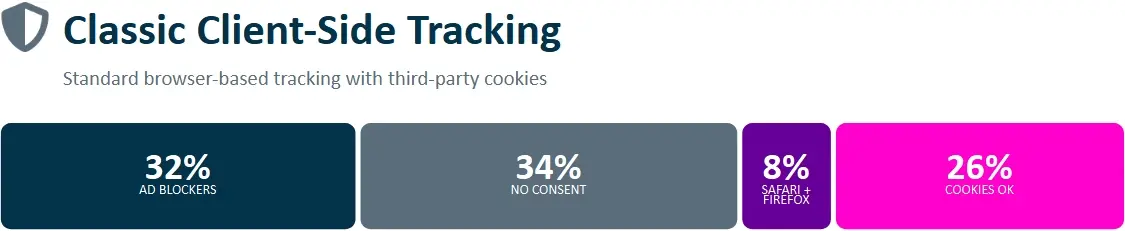
- In 2025, standard tracking captures only about 25% of real traffic.
- Three causes that add up: GDPR, blocked third-party cookies and ad blockers (30%+ of users in Europe).
- The solution: first-party data + server-side tagging + an optimised cookie banner.
When your dashboards stop telling you anything, your entire marketing management is on shaky ground.
Monday morning, you open your dashboard. Google Analytics shows one trend. Google Ads shows another. The CRM tells a third story. At the management meeting, the question is inevitable: "What is the ROI of our campaigns?" Hard to give a simple answer.
This affects every company that invests in digital advertising. As soon as the amounts become significant, tracking quality becomes a business issue. Without reliable data, there is no way of knowing whether a campaign is profitable or not.
Are your dashboards telling
the right story?
Let's assess it in 30 minutes
Why your data no longer adds up
The symptoms keep coming back. Unexplained gaps between platforms. Conversion rates that fluctuate with no change in strategy. A growing share of traffic classed as "direct" or "unknown", the catch-all categories where incomplete data ends up.
Faced with these unknowns, you compensate. Correction factors. Estimates. Gut feeling. In the end, you no longer trust your own figures.
The tracking that worked a few years ago no longer works. Not because it was badly set up, but because the rules have changed.
Consent has become the norm
GDPR, cookie banners, users declining tracking. Tracking used to be on by default. Now, only consented interactions are measured. The result: almost half of your visitors can become invisible.
Browsers are restricting third-party cookies
Safari and Firefox already block third-party cookies. Chrome leaves the choice to the user, and these cookies are becoming less and less effective. Multi-channel attribution is deteriorating. Linking a conversion to the ad that triggered it is becoming difficult.
Ad blockers are becoming widespread
More than 30% of users in Europe use them. They block ads, but also tracking scripts. As a result, part of your traffic is never measured.
These three factors add up. With standard tracking, you only see about 25% of what is happening. And what you do see is not necessarily representative.
How this hurts you in practice
Faulty tracking does not trigger an alert. It does not crash. It misleads you silently.
Decisions built on thin air
Without reliable attribution, there is no way of knowing which channel really delivers results. Budgets get managed on the basis of wrong information. For example: a LinkedIn campaign seems to underperform because its conversions are attributed to "direct". Its budget is cut, then leads fall, and nobody can make the connection.
In practice, it is common to see acquisition costs double for no apparent reason, or even cases where managing campaigns becomes impossible for lack of sufficient data. And when you want to optimise? If the data is wrong, the optimisations probably are too.
Credibility that crumbles
Marketing can no longer prove its contribution to revenue. In management meetings, the figures are questioned, or even ignored. That brings the risk of reduced budgets, a sidelined team and a loss of strategic influence.
And in the background, there is a regulatory risk: badly configured tracking can collect data without valid consent. GDPR fines exist and can be imposed, even if this remains rare.
Moving to reliable tracking
Solutions exist. They require an investment, but they give you a clear view again.
Focus on first-party data
First-party data is the data you collect directly: forms, CRM, sales data. It belongs to you. No one can take it away from you, not a browser, not a regulation, not Google.
This data needs to be put back at the heart of your tracking, either by feeding it into your tracking tools or by connecting it with other statistical data.
Switch to server-side tracking
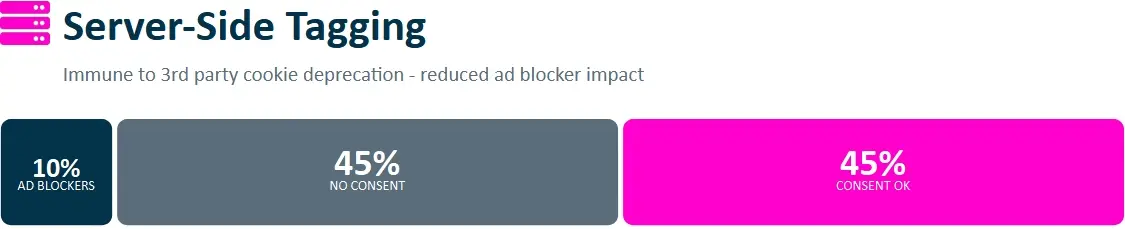
With conventional tracking, scripts run in the browser. The problem is that this is exactly where ad blockers step in. It is also where the restrictions apply.
Server-side tracking moves most of the execution to your server. Three benefits: ad blockers have less impact, cookies become first-party, and you control what is sent.
Implementation requires technical skills. But for companies with significant advertising budgets, the return on investment is quick.
Manage consent properly
Consent is a legal constraint, but above all it is the first lever for recovering data.
A well-designed cookie banner can raise the acceptance rate from 40% to 70%. The difference quickly adds up to thousands of tracked sessions every month.
Configuring Google Consent Mode correctly is essential for any company using Google services. For high-traffic websites, Google Consent Mode collects anonymised signals even when the user declines, in order to model missing conversions.
What you gain
A more accurate view of the customer journey. Attribution that better reflects reality. The ability to measure the ROI of your campaigns. And above all, confidence in your own data.
Tracking is a technical subject, but above all it is a pillar of marketing governance. Mastering your data means being able to base your decisions on facts, with a better chance of getting results.
Taking back control of your data improves your ability to make decisions.
Let's talk about your tracking challenges
(30 min, free)



 Want similar results?