
At a glance
The story in four acts
The client
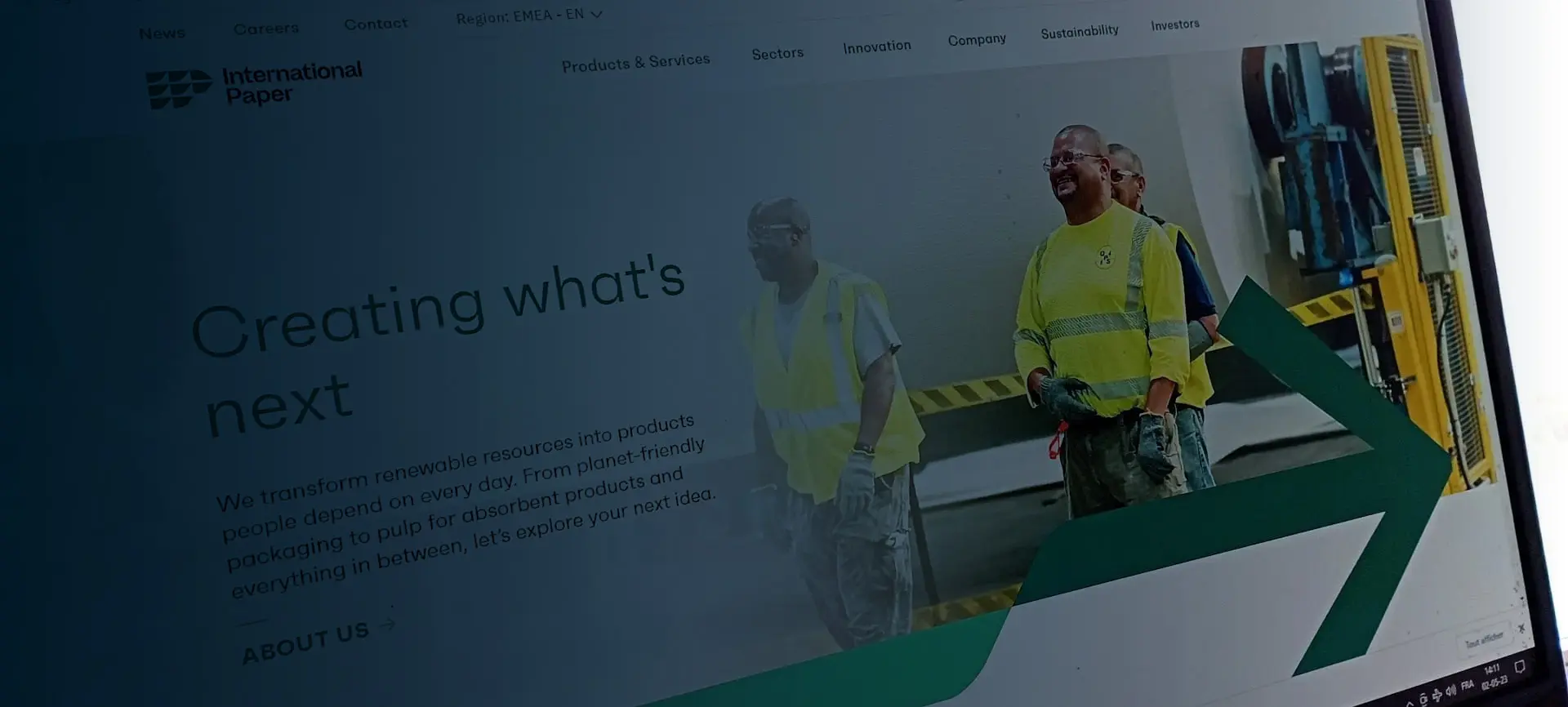
International Paper, one of the world's largest producers of fibre-based packaging, is redesigning its corporate website from its Memphis headquarters. The EMEA region, with its six languages, needs to find its rightful place in it.
The challenge
Making the needs of a multilingual region heard in a global project, with an overly complex existing website and local teams already stretched thin.
The approach
An outsourced project manager, neutral and attentive: a structured team, needs documented and championed with the global team, clear roles for content, and well-organised translations.
The result
A new global website launched on schedule, with automatic localisation, country pages and versions in the region's six languages, rolled out in phases.
01 The client
A global group that wants a website in its own image
International Paper (IP) is a global producer of sustainable packaging, pulp and other fibre-based products. The group is one of the world's largest recyclers, with mills and customers on several continents.
In Europe, the Middle East and Africa, IP mainly produces corrugated packaging for industry, food, fruit and vegetables and e-commerce, with sites in France, Spain, Portugal, Italy, Morocco and Poland, and a service centre in Kraków.
The group then launched the "Building a Better IP" project: replacing internationalpaper.com, an ageing website hosted on internal servers. The spin-off of the paper business (Sylvamo), the new customer promise and Vision 2030 had changed the way IP presented itself. The future website had to be cloud-based, customer-focused, personalised to the visitor's location, and become the true centre of the group's online presence.
The project was run from the Memphis headquarters, with an implementation agency in charge of the technical side. The EMEA communication manager was looking for a project manager who could understand the region's needs, coordinate the entire EMEA contribution and bring an outside, neutral perspective. She entrusted this role to Be-one.
02 The challenge
Giving a region a real place in a global project
On paper, the job was to supply content for a new website. In practice, four difficulties piled up:
A global project conceived in the United States
CMS choice, implementation agency, workshops, timeline: the final decision lay with Memphis. EMEA accounts for a small share of group revenue, yet faces major European competitors there. Without a strong voice, the new website risked being American before it was global.
An existing website that was hard to use
Too much content, conceived as an encyclopaedia rather than a communication tool, a menu that mirrored the internal organisation, an EMEA section that was hard to find, generic photos and a careers page heavily focused on the United States.
Six languages and very different markets
Each country has its own products, customers, job market and news. We had to decide what to translate, into which languages and for whom, without multiplying pages that would be impossible to maintain.
Local teams already under heavy pressure
Product marketing, human resources, communication: the EMEA experts contributed to the project on top of their day-to-day work, in a group still reorganising after the spin-off.
The real risk with a global website is a region that discovers the result on launch day: navigation that does not fit its customers, missing local content, rushed translations. Followed by months of corrections.
Be-one therefore acted as the single point of contact between the EMEA team and the global team: listening to internal needs, consolidating them, championing them with the US team, which had the final say, and following up every decision, from the first workshop to the last translation.
03 The approach
An outsourced project manager, from kick-off to go-live
Be-one handled project management and regional coordination for 14 months, embedded in International Paper's teams to reinforce the EMEA communication team. The technical side (CMS, development) remained with the global team's agency. Be-one focused on needs, structure, content and translations. The common thread:
EMEA kick-off audit of the existing website personas and benchmark discovery workshops structure and navigation RACI and content copywriting translations go-live
A structured EMEA team and a fixed rhythm
From the EMEA kick-off, Be-one organised the region's contribution: an extended team of 13 people representing communication, sales and marketing, HR, Kraków and procurement, plus a core working group of five. Steering sessions once or twice a month, workshops in between, and after every meeting, the presentations, decisions and everyone's tasks shared with the team.
Needs documented before being championed
An audit of every section of the existing website with a "Start / Stop / Continue" list, an analysis of visitors and their expectations, personas completed by the business teams (packaging buyer, job applicant, recruitment agency, student): genuine B2B personas, followed by a benchmark of leading B2B websites, competitors included. Every EMEA need thus reached Memphis backed by arguments and documentation.
The voice of EMEA in every workshop
Be-one gave the region's view on the choice of the new CMS, Drupal, with the final decision resting with the global team. It then represented EMEA in the discovery workshops run by the implementation agency: products and positioning, marketing and technology, content. And it secured a dedicated EMEA session, with nine members of the regional team, to address country personalisation, languages and the link between global and local content.
A structure designed for European visitors
EMEA feedback shaped the navigation: automatic country selection, a menu by sector then sub-sector, country pages with local news, a suppliers page and general terms and conditions of sale. Languages were chosen on the basis of sales data: Polish limited to certain pages, no German, Russian or Arabic. In the meantime, an EMEA homepage was added to the old website.
Clear roles for producing content
For each section (products, careers, Kraków), a RACI matrix set out who writes, approves and reviews. Copywriting followed a single process: a template per page, drafting in English by the content owner, EMEA review, global team review, then translation. A shared tracker showed the status of every page. For the country pages, a short questionnaire let each local team choose its flagship products and the news to highlight.
Translations organised, not endured
Native-speaker reviewers assessed two agencies on real excerpts before the translation solution, integrated into the CMS, was chosen. Glossaries for each language, reviewers assigned to each section and trained on the tool, and translations launched in three phases to fit their workload. A shared tracker followed every page through to approval.
04 The result
A website live on schedule, designed with EMEA in mind too
The new internationalpaper.com went live on schedule. EMEA visitors are recognised automatically and land on their own country, with a clear menu built around sectors and products, less text, more images and country pages fed with local news. Versions in the region's languages followed in phases over the next few weeks.
The collaboration continued after launch, as part of a long-standing partnership: an EMEA newsletter in six languages, translation of press releases for the website, and support for the EMEA team during the redesign of the IPNet intranet.

“Thank you for your leadership and the coordination with the EMEA team in launching the new internationalpaper.com website on schedule. You brought enormous value to this project, and your contributions are helping IP improve communication with customers in the EMEA region.”
Key learnings
Main takeaways
A region makes itself heard with arguments
Personas, audit, benchmark, sales data: a documented need carries more weight than a request, especially when facing a global team spread across several time zones.
An outside, neutral perspective between local and global
An external project manager listens to every team with no internal agenda, consolidates feedback from an entire region and champions it with a single voice. Decisions get made faster.
Translate less, but better
Not every page needs every language. Deciding on the basis of market data keeps the website maintainable and focuses effort where it counts.
Roles defined before content
A RACI matrix per section states who writes, approves and reviews. Content then moves forward without constant chasing.
Respect the experts' time
The reviewers are also salespeople, HR staff and marketers. Preparing the work, grouping requests and phasing translations keeps them engaged right to the end.
Don't wait for the new website to improve
The EMEA homepage added to the old website served as a test: the ideas it validated fed directly into the structure of the new one.
FAQ
Frequently asked questions about managing an international website project
Why bring in an outsourced project manager for a new website?
To strengthen an already busy team without hiring, and to bring an outside, neutral perspective. The project manager listens to internal needs, documents them (audit, B2B personas, choice of languages) and champions them with the decision-makers and the technical agency, who remain responsible for building the website.
How do you give a region a real place in a global website?
By preparing its needs before the workshops: an audit of the existing website, personas, a competitive benchmark and market data. For International Paper, this work secured a dedicated EMEA session, automatic localisation by country and country pages with local news. Another example: the redesign of EFESO's global website.
Should you translate the whole website into every language?
No. At International Paper, languages were chosen according to the markets served: six languages for EMEA, Polish limited to certain pages, and no translation where sales did not justify it. PDF documents in the local language can fill the gap where needed.
How do you organise translation review across several countries?
With a translation tool integrated into the CMS, a glossary for each language, expert reviewers assigned to each section and trained on the tool, a shared tracker and a phased rollout. Reviewers approve in the tool, and the pages are created automatically.
Can Be-one manage a web project within your teams?
Yes. For International Paper, Be-one was embedded in the organisation as EMEA project manager, alongside the global team and its technical agency. You keep a single point of contact who coordinates your teams, your content and your deadlines.
About Be-one
Be-one is a B2B growth agency in Belgium: strategy, branding, print and POS, communication, lead generation, CRO, UX, development and HubSpot expertise. We help marketing managers turn their campaigns into tangible results, in Dutch, French and English.
 Want similar results?